# 329-longest-increasing-path-in-a-matrix Try it on leetcode ## Description

Given an m x n integers matrix, return the length of the longest increasing path in matrix.

From each cell, you can either move in four directions: left, right, up, or down. You may not move diagonally or move outside the boundary (i.e., wrap-around is not allowed).


Example 1:
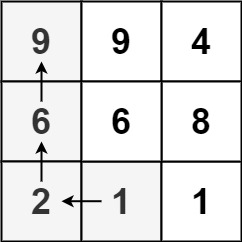
Input: matrix = [[9,9,4],[6,6,8],[2,1,1]]
Output: 4
Explanation: The longest increasing path is [1, 2, 6, 9].

Example 2:
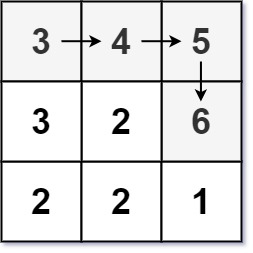
Input: matrix = [[3,4,5],[3,2,6],[2,2,1]]
Output: 4
Explanation: The longest increasing path is [3, 4, 5, 6]. Moving diagonally is not allowed.

Example 3:

Input: matrix = [[1]]
Output: 1


Constraints:

## Solution(Python) ```Python class Solution: def __init__(self): self.neighbours = [(1, 0), (-1, 0), (0, 1), (0, -1)] def longestIncreasingPath(self, matrix: List[List[int]]) -> int: return self.topdown(matrix) # Time Complexity: O(m*n) # Space Complexity: O(m*n) def topdown(self, matrix: List[List[int]]) -> int: # determine m,n self.m, self.n = len(matrix), len(matrix[0]) self.max_len = 0 self.matrix = matrix return max(self.dfs(i, j) for j in range(self.n) for i in range(self.m)) @cache def dfs(self, i, j): val = self.matrix[i][j] return 1 + max( self.dfs(i - 1, j) if i and val > self.matrix[i - 1][j] else 0, self.dfs(i + 1, j) if i < self.m - 1 and val > self.matrix[i + 1][j] else 0, self.dfs(i, j - 1) if j and val > self.matrix[i][j - 1] else 0, self.dfs(i, j + 1) if j < self.n - 1 and val > self.matrix[i][j + 1] else 0, ) ```