2385-amount-of-time-for-binary-tree-to-be-infected
Try it on leetcode
Description
You are given the root of a binary tree with unique values, and an integer start. At minute 0, an infection starts from the node with value start.
Each minute, a node becomes infected if:
- The node is currently uninfected.
- The node is adjacent to an infected node.
Return the number of minutes needed for the entire tree to be infected.
Example 1:
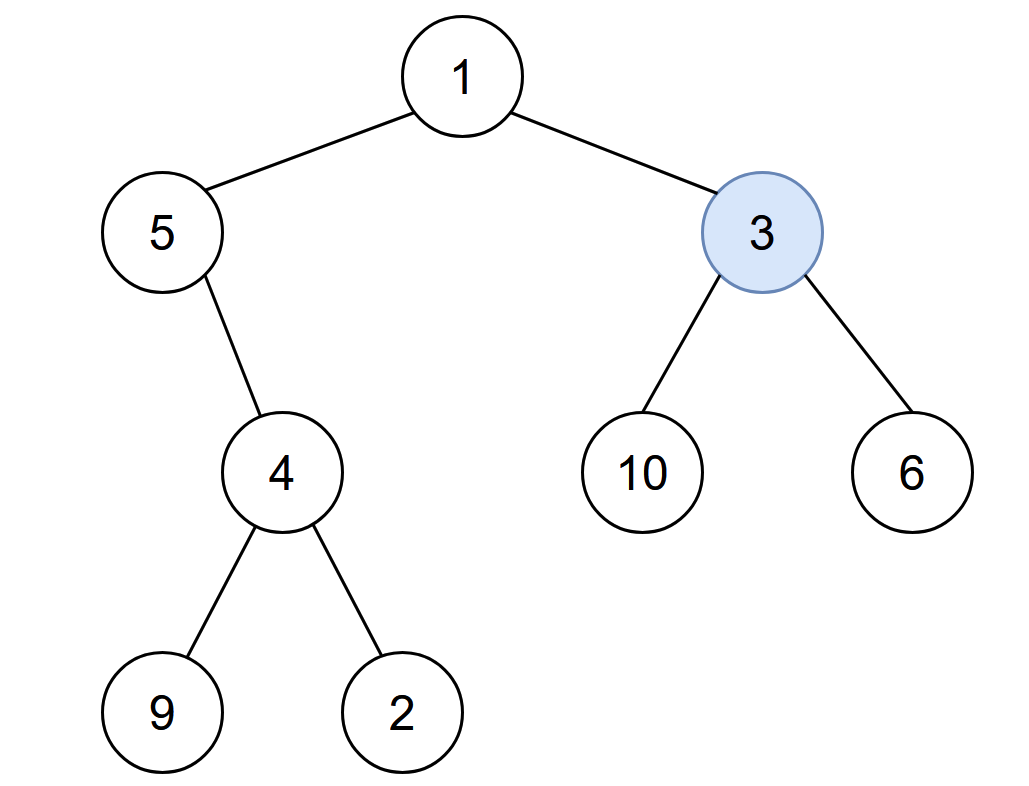
Input: root = [1,5,3,null,4,10,6,9,2], start = 3
Output: 4
Explanation: The following nodes are infected during:
- Minute 0: Node 3
- Minute 1: Nodes 1, 10 and 6
- Minute 2: Node 5
- Minute 3: Node 4
- Minute 4: Nodes 9 and 2
It takes 4 minutes for the whole tree to be infected so we return 4.
Example 2:

Input: root = [1], start = 1
Output: 0
Explanation: At minute 0, the only node in the tree is infected so we return 0.
Constraints:
- The number of nodes in the tree is in the range
[1, 105]. 1 <= Node.val <= 105- Each node has a unique value.
- A node with a value of
startexists in the tree.
Solution(Python)
# Definition for a binary tree node.
# class TreeNode:
#     def __init__(self, val=0, left=None, right=None):
#         self.val = val
#         self.left = left
#         self.right = right
from collections import defaultdict, deque
class Solution:
    def amountOfTime(self, root: Optional[TreeNode], start: int) -> int:
        return self.onepass(root, start)

    # TIme complexity: O(n)
    # Space complexiy: O(n)
    def twopass(self, root: Optional[TreeNode], start: int) -> int:
        # 1 build the graph from tree make connectionfrom node -> parents
        graph = defaultdict(list)
        def buidlGraph(cur, parent):
            if cur is not None and parent is not None:
                graph[cur.val].append(parent.val)
                graph[parent.val].append(cur.val)
            if cur.left is not None:
                buidlGraph(cur.left, cur)
            if cur.right is not None:
                buidlGraph(cur.right, cur)
        buidlGraph(root, None)
        # 2 run dfs from the start node and track the maximum length by a max _length variable
        max_len = 0
        queue = deque([(start, 0)])
        visited = set([start])

        while len(queue) > 0:
            node, distance = queue.popleft()
            if distance > max_len:
                max_len = distance
            for neighbour in graph[node]:
                if neighbour not in visited:
                    visited.add(neighbour)
                    queue.append((neighbour, distance+1))
        return max_len

    # TIme complexity: O(n)
    # Space complexiy: O(n)
    def onepass(self, root: Optional[TreeNode], start: int) -> int:
        max_distance = 0
        def traverse(root, start):
            nonlocal  max_distance
            depth = 0
            if root is None:
                return depth

            left_depth = traverse(root.left, start)
            right_depth = traverse(root.right, start)

            if root.val == start:
                max_distance = max(left_depth, right_depth)
                depth =  -1
            elif left_depth >= 0 and right_depth >= 0:
                depth = max(left_depth, right_depth) + 1
            else:
                distance = abs(left_depth) + abs(right_depth)
                max_distance = max(max_distance, distance)
                depth = min(left_depth, right_depth) - 1
            return depth
        traverse(root,start)
        return max_distance